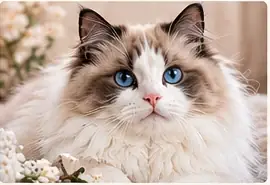
A blue-eyed companion with a social reputation and a silky, semi-long coat. The best reason to choose a Ragdoll is a relationship you can nurture, rather than an expectation of a permanently floppy cat.
The Ragdoll was developed in California in the 1960s by Ann Baker, with Josephine among the foundation cats. The breed later gained wider recognition through other breeders and associations, and arrived in the UK in the early 1980s.
Its appearance combines a substantial frame, semi-long coat, blue eyes and colourpoint colouring. Familiar patterns include colourpoint, mitted and bicolour. Kitten colour develops with age, so a pale baby coat is not a permanent picture of the adult.
A companion, not a soft toy
Many Ragdolls enjoy being close to people and joining the routine of the home. They can be playful as well as relaxed. Sharing a room, following you between activities or joining a quiet evening can all be ways of seeking company.
The name does not promise that a cat will go limp when picked up. Ragdolls feel pain and can be frightened like other cats. Support the body properly, stop if a kitten struggles and never encourage a child to carry a cat as though it were a toy.
Why families love them — and what to plan for
This can be a good match for someone who values daily companionship and is willing to keep a coat in good condition. A social kitten needs a plan for workdays, holidays and gradual settling; a bowl of food is not the whole care arrangement.
A large adult also needs appropriately sized resources. Choose a carrier, litter tray, scratching post and resting spaces that will still be useful as the kitten grows. A fashionable small tray or flimsy tower may be less practical than a generous, stable one.
Enjoy: sociability, play and a close day-to-day relationship.
Plan for: coat care, space for adult-sized equipment and a reliable daily care routine.
Avoid assuming: every Ragdoll loves lifting, every child or every other pet.
Caring for the silky coat
Start with several short grooming sessions each week and adjust to the individual coat. Pay attention to behind the ears, the chest, under the forelegs, the belly and the hindquarters. During moulting, more frequent combing may be needed.
A silky feel does not make a coat impossible to mat. Find tangles early and keep sessions gentle. A kitten learns more from two relaxed minutes than from being held through a long struggle. Seek grooming help for mats that cannot be comfortably combed out.
Check the rear after soft stools, practise paw handling and introduce cat-specific dental care gradually. Hairball products do not replace grooming, and repeated vomiting is not something to label a harmless breed trait.
Making home life work
Offer a quiet first room with familiar food, litter and bedding. Build access to the rest of the home in manageable stages. Provide interactive play, scratching surfaces and resting places away from household traffic.
With children, reward calm approaches and teach when to leave the kitten alone. With another cat, begin separately and introduce scent before close contact. With a dog, prevent chasing and keep a cat-only refuge. Do not rush introductions because both animals are described as friendly.
HeartNest Cattery kittens are placed for indoor life or secure, suitable supervised access. An affectionate or trusting cat still faces risks from traffic, other animals and escape; unrestricted free roaming is not accepted.
Health questions & the documents for our litter
Ask about Ragdoll-relevant HCM testing in the parents and the scope of the results. A DNA test for a known variant does not exclude all causes of heart disease. Match any result to the named cat and discuss its date and meaning.
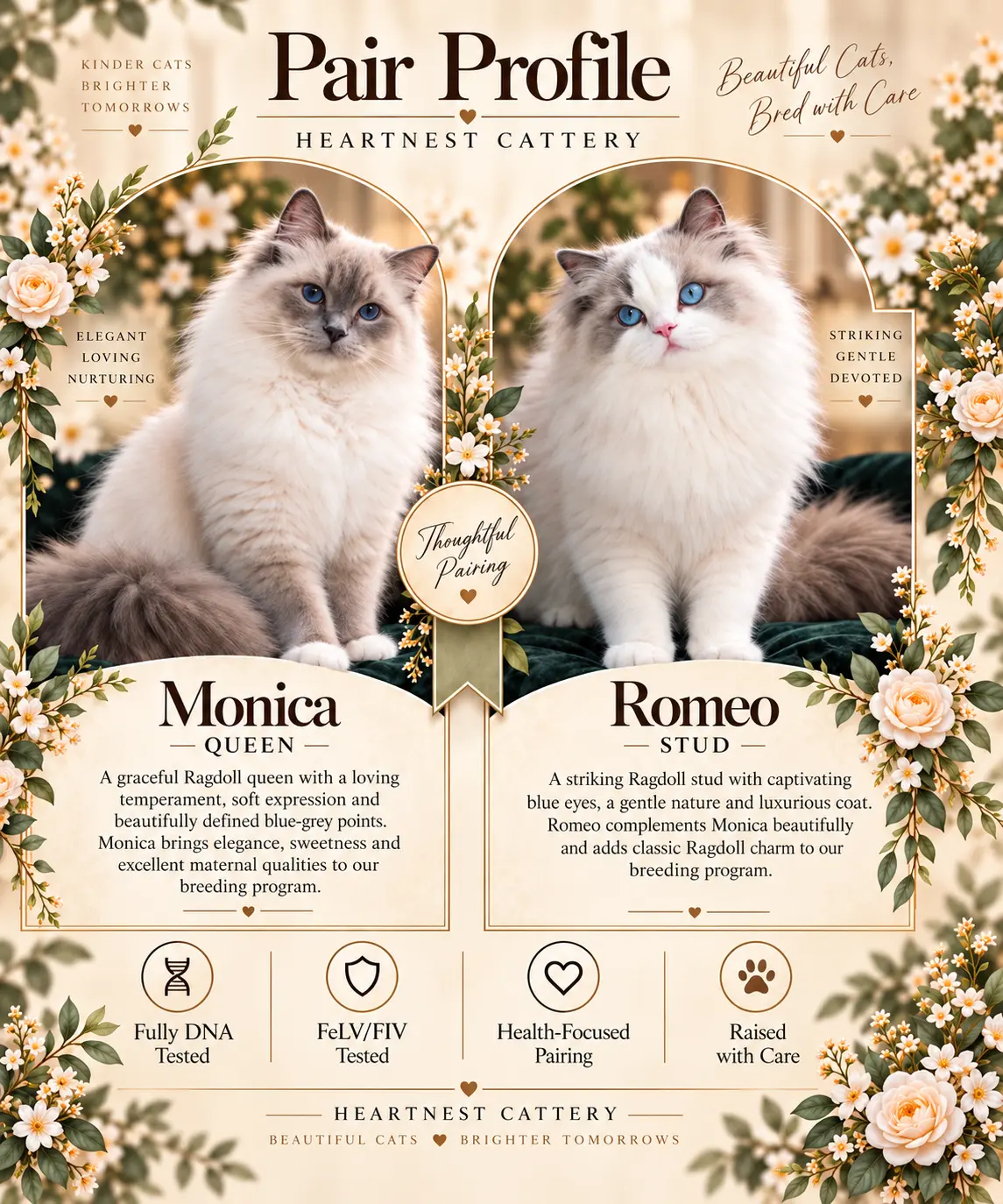
Monica and Romeo are registered with both TICA and GCCF. Their current kittens will use the TICA registration route, rather than being described as automatically registered in both. The exact documents and release arrangements are stated in the placement agreement.
The current litter page lists all four kittens, including reserved littermates, with the full care pack, individual prices and the available boy’s photographs.
The cats behind the programme
Meet the cats
Get to know the parents and future breeding cats connected with this programme. Current kitten availability and registration are stated separately for each litter.
Shared pair profile · Monica and Romeo
Our queen · Ragdoll
Monica
Mother of our current Ragdoll litter. Her kittens are shown individually with their latest status, so reserved kittens remain part of the litter story.
Health & registration
TICA and GCCF registered.
Her current litter with Romeo will be registered with TICA.
Sire of our current Ragdoll litter
Romeo
Romeo is the father of Monica’s current kittens. His identity and registration are separate from the individual kittens’ TICA paperwork.
Health & registration
TICA and GCCF registered.
Parent testing evidence relevant to the litter can be discussed before reservation.
Understanding the health records
A DNA panel, a heart scan and an infectious-disease test answer different questions. A clear DNA result covers the variants tested; it does not rule out every illness. A normal scan and a negative infection test describe the examination or sample date. Ask us about the named parents and the evidence relevant to your chosen litter before reservation.
Registry paperwork and pedigrees are discussed for the individual litter. A HeartNest Cattery presentation pedigree supplements association documents and does not turn an unregistered kitten into a registered one.
Reviewed October 2026. Breed tendencies are a guide; each cat is an individual. Care information supports, and does not replace, advice from your own veterinary practice.
Could this be your HeartNest Cattery companion?
Tell us about your household, daily routine and the qualities you value. We match the individual kitten as well as the breed.